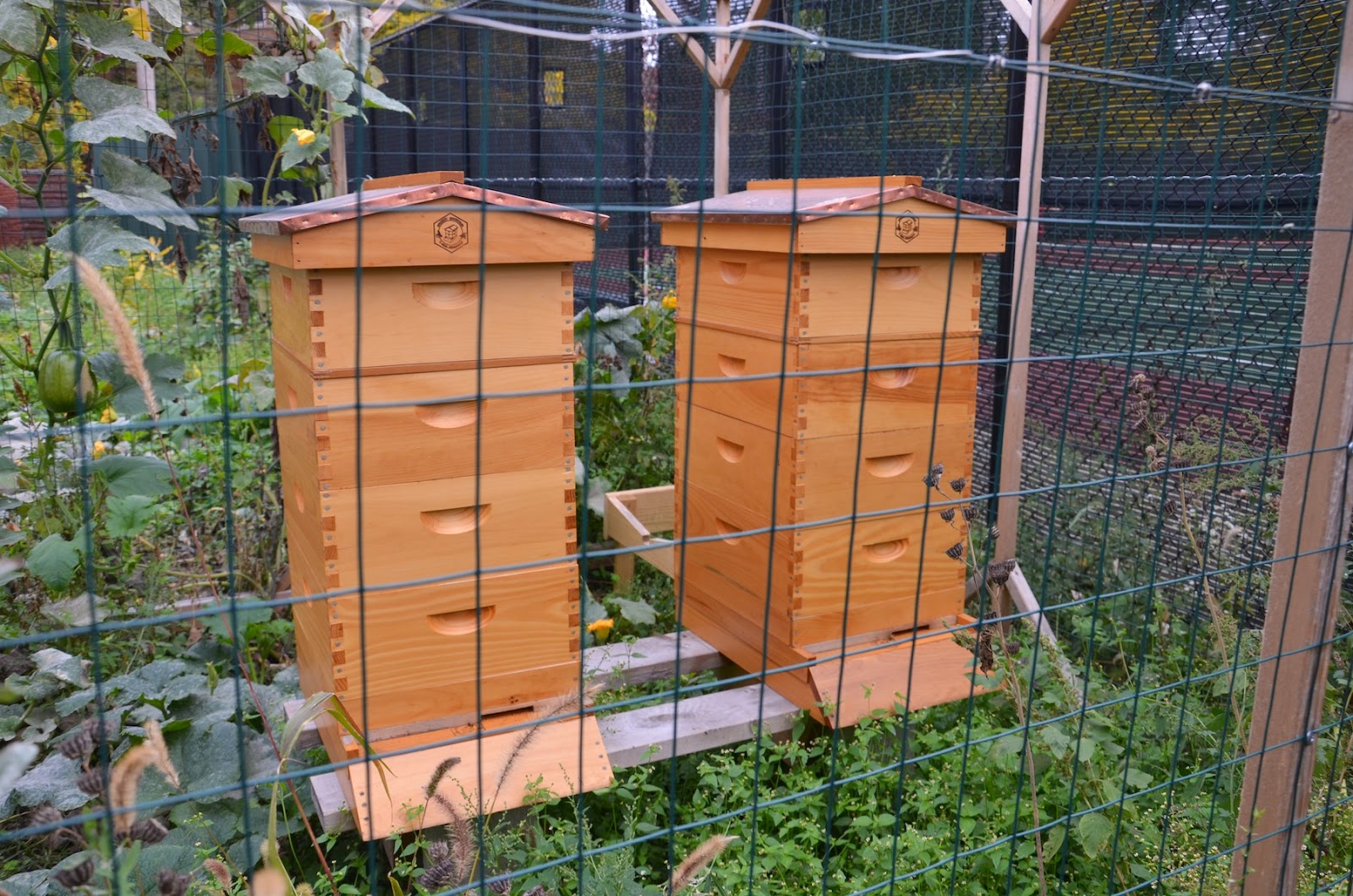
 Having the bees in the garden has allowed several nursery, primary and lower school classes to explore the fascinating world of bees.
Students are curious about the hives, the stings and, of course, the honey
The following is a transcript of a conversation that occurred at the end of the bee's summer honey producing season between a class of nursery students and their teachers Meredith, Steve & Tomoko. They had some great ideas the bees and about honey. For the best effect read in 'teacher' and 'kid' voices.
M:
Now, what do we know about bees? We’ve talked about bees before.
Having the bees in the garden has allowed several nursery, primary and lower school classes to explore the fascinating world of bees.
Students are curious about the hives, the stings and, of course, the honey
The following is a transcript of a conversation that occurred at the end of the bee's summer honey producing season between a class of nursery students and their teachers Meredith, Steve & Tomoko. They had some great ideas the bees and about honey. For the best effect read in 'teacher' and 'kid' voices.
M:
Now, what do we know about bees? We’ve talked about bees before.
Adrian:
Sting!
M:
Bees sting. Thomas? Did you have your
hand raised or are you just touching the wall?
Thomas:
Bees get nectar from flowers.
M:
Bees get nectar from flowers. Conrad?
Conrad:
Bees die after they sting.
M:
Bees die after they sting. That’s right. And Saheer.
Saheer:
Well, bees make honey.
M:
Bees make honey. Do you remember we
talked about last week or the week before last about how bees make honey?
Children:
Yeah.
M:
Did we come up with an idea about how they make honey?
Child:
Sweet honey.
M:
Sweet honey. Orlie?
Orlie:
Umm, bees, they get the nectar from a flower then they store it in the bee hive.
M:
They get the nectar from the flower. They store it in the bee hive. Anyone else, Sophie?
Sophie:
Bees I know in the store and they make bee honey for the shop and they put them
in the honey bears and they buy some.
M:
Okay, Mr. Steve could you bring the tray down for us please? There’s a cycle the bees go through to make
honey. But before bees make honey they
have to become a bees. Now, this is the
brood tray. These are in the apiary that the high school science teachers built
with their students. This is their
hive. Now, in the book The Bee Tree, the hive is in the bee
tree and wasn’t was not made for them. They made their own bee hive. But we have a special house for the bees and
its called an apiary that I think Thomas’s mom helped build. She helps take care of the bees.
Thomas:
My mom works at the Lab School.
M:
Yes, she’s a science teacher, a scientist.
So the bees, just like babies, you know we’ve been talking a lot about
babies-
Thomas:
Yeah, and we’re making a baby book.
M:
Yes, we’re making a baby book. The bees
have to be born too, and there’s a cycle that they go through. The queen bee lays an egg in one of these
little holes. And then- (M uses
small bee toys to act out the story).
Eva:
Could we act it out?
M:
We could act it out. And then they grow inside until they wiggle out of the
hole. They actually eat part of their
home that they’ve been growing in and when they eat part of their home it gives
them strength to get out, and then they wiggle wiggle wiggle and then their wings
spread. Bzzzzz Where do you think they
go?
Children:
To get nectar!
M:
Where do they get the nectar?
Children:
From flowers!
M:
Remember, we acted that out. Adrian, you
volunteered. Would you like to act it out? What would you like to be? Are you thinking? Would you like to act it out now or later?
Adrian:
Now.
M:
Now?
(Children
all shout out at once “Me too”)
M:
So let’s all act it out, we’ll all become bees.
(Children
bend over on their hands and knees, heads to the floor. Meredith narrates the story
of a bee being born and children move their bodies accordingly.)
M:
The queen bee just laid an egg.
Edward:
I don’t want to be a bee.
M:
You can choose to not be a bee. Now, one
day passes, two days pass, three days pass, four five six seven eight nine days
pass and you have been growing bigger. You were first and egg but now you’re a
larvae and you’re wiggling. You’re wiggling. You have little eyes you’re
starting to see some light. And then you’re a pupae. And you kind of look like a bee that we know.
One day passes in the pupae, two three four five six seven, and on the eight
day you eat your way through the top and wiggle wiggle up. You put one wing
out. You put the other wing out. And you’re free and you come to the flower.
And I’m the flower, and then you go back to the hive and you take the pollen
and you put it (Children make buzzing sounds and move to M then back to
their seats) to the queen bee. But this
is all I know. Where does the honey come
from?
Children:
The flowers.
M:
Yes, but -
Child:
They make the nectar into honey.
M:
Yes, nectar into honey, but how does that happen. Let’s hear some ideas about
how the nectar, the pollen, becomes honey.
Because I remmeber someone was just saying, Sophie, that we can go to
the store and buy honey in honey bears just like this. But how does the honey
get in here. Mr. Steve, will you go get
the special thing we have in the refrigerator?
So, we were an egg. We grew to a larvae. We became pupae. Then we became adult bees. We flew and got pollen. We went back to the
hive, and then...
Thomas:
We gave the honey to the queen.
M:
(Holds up a second comb) Now, does this look about the same as this?
Children:
No.
Thomas:
Brown
M:
One is brown and one is white.
Bryce:
That one doesn’t have the nectar.
M:
No, this one does, right? This is where
they were born. And this is where they find the honey. Still curious, how does it
become honey? Hmmmm...
Adrian:
You need to be a bee to figure it out.
M:
You need to be a bee to figure it out.
Children:
Yeah.
Thomas:
Umm, if you get bees in your pants it could sting your legs.
M:
Ouch, that reminds me. We saw your mom and Mr. Maharry, and who else did we see
Mr. S?
Mr.S:
Dr. Calleri
M:
We saw them and what did they have on?
Thomas:
Masks.
M:
Their masks and their bee suits. why?
Thomas:
Because then the won't get stinged. But bees went up my mom’s leg.
M:
That’s right, even though they were protected, the bees went up the leg or they
stung
their hands. Why? Why would they sting? What were they trying
to do?
Zack
H: Protect their honey.
M:
Yes Zack, protect their honey. Or
protect, what else?
Children:
Their hives or their babies.
M:
Just like our moms and dads protect us. It’s the same cycle. I do things to
protect my son. But not sting.